Current Projects
Genetic Architecture of Maternal and Maternally
Controlled Traits in Arctic Charr
The aim of this 3-year project is three-fold. The first goal is to quantify the direct and maternal genetic (co)variation for several traits expressed either in mothers (maternal traits, e.g., egg size, fecundity) or in both female and male Arctic charr (Salvelinus alpinus) and which are influenced by maternal traits (maternally controlled traits, e.g., early offspring survival and size). To reach this first goal, we will use quantitative genetic methods on existing records from the Icelandic Arctic charr breeding programme. The second goal is to identify and quantify effect sizes of genetic markers (co)associating as direct genetic effects with maternal traits. To reach this goal, we will employ a single-step genome-wide association study (ssGWAS) on maternal traits that also utilises long-term breeding-programme records, but that we complement with genetic marker data from low-coverage whole-genome-sequencing (lcWGS). The third and most ambitous goal is to identify genetic markers associating as maternal genetic effects with maternally controlled traits, i.e., genetic marker variation among mothers that associates with trait variation in their offspring and is not explained by offspring genetic variation, also using ssGWAS, and allowing implementation of a cost-effective statistical predictive framework. This project will hopefully provide novel fundamental knowledge about the genetic architecture of important traits, which may or may not be under maternal co-control, and foundations for applications in not only existing Arctic charr breeding programmes but also other farmed and wild populations. The project thus targets unravelling genetic components and ways to efficiently select for fitness traits that may deteriorate rapidly when ignored or inappropriately selected for in hatcheries serving aquaculture or conservation.
An Icelandic Research Fund is financing this project led by Paul and conducted in collaboration with Einar Svavarsson from the Icelandic Arctic charr breeding station and Christos Palaiokostas from the Swedish University of Agricultural Sciences.

Project Updates
We have now finished an analysis of two maternal traits that are critical to reproductive success, namely egg size and fecundity, and how they covary with growth traits expressed prior to or at maturation. We found that egg size and fecundity correlate negatively but weakly at both the phenotypic and the environmental levels but not at the genetic level. Phenotypically, egg size and fecundity each correlate positively and weakly to moderately with prior growth and size at maturation. Furthermore, fecundity correlates also with prior body condition. Genetic correlations with prior growth are positive for both egg size and fecundity, but weaker for egg size. Contrarily, environmental correlations with prior growth are of opposite sign between egg size and fecundity, also weaker for egg size, and effect decreasing egg size and increasing fecundity under beneficial prior growth. A paper based on these results has been published in Evolutionary Applications.
We have also finished (but see next paragraph) the sequencing (HiFi and Hi-C) for a de novo reference genome assembly of the Icelandic Arctic charr from the Icelandic breeding programme and now hold a first draft genome. A comparison with a similar result of the Swedish Arctic charr by Christos (from the Swedish breeding programme, available here) indicates that we are on a good way to having two reference genomes of high quality, which are of much benefit to the upcoming genomic analyses of the current and potential future projects. We are looking forward to annotate the reference genomes with RNAseq data.
As an update, we have now added ultra-long ONT sequences to re-assemble the Icelandic genome. We had hoped that this would be a very useful addition due to the residual tetraploid state of the Arctic charr genome. Many genes are duplicated and it is a challenge to differentiate between haplotigs and truly repeated regions containing long homozygous streches, which may have resulted from genome duplications and especially the salmonid-fish-specific genome duplication. The new assembly yielded twice as long contigs, but the resulting scaffolds are very similar to the previous assembly without ultra-long ONT sequences.
We have also started with lcWGS and high-coverage sequencing of individuals to construct a haplotype panel that allows for better data imputation of the upcoming lcWGSs. We were uncertain about DNA quality of tissue samples going all the way back to 2008 because of a relatively high tissue-to-ethanol ratio in the tubes and because they may have experienced several freeze-thaw cycles due to recurrent power outages in the small valley where the breeding programme is located (and the freezer holding the samples); both may lower DNA quality by increasing its degradation. However, the quality of extracted DNA from samples across all years turned out to be quite good and we are now confident that we will be able to obtain high-quality lcWGSs for even the individuals that provided tissue samples many years back.
Now we have also started processing ~ 1,250 female samples for lcWGS so that we can conduct the GWAS for maternal traits, such as spawning time, egg size and egg number. This may take some time.
The low-coverage whole genome sequences have allowed us to extract mitogenomes. The original purpose is to verify the maternal lines of the pedigree going back to the late 1980ies when wild-origin females were added to the breeding programme. However, the many whole mitogenome data are interesting themselves. Some preliminary results are summarised in this poster (tailored towards an audience residing in Iceland). Paul will present the poster at Líffræðiráðstefnan, the IceBio2025 conference (https://biologia.is/liffraediradstefnan-2025/). Another interesting finding is the presence of multi-generational heteroplasmy in some female lines, and which requires further investigations. More mitogenomes are waiting to be assembled.
Previous Projects
Sex Difference in Spider Body Size Architecture (concluded)
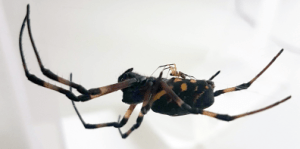
Sexual size dimorphism occurs when individuals from one sex are larger than those from the other sex. In many species, including spiders, the female is larger then the male. It is commonly assumed that larger females may produce more or better offspring but that smaller males may be better at other tasks. In spiders, this may be adventuring towards female spider webs. In the African hermit spider (Nephilingis cruentata) males that successfully found a female, will often wait in her web until her final moult and only then can they copulate (if they are not eaten by her). The females are around 80 times heavier than the males. How can such a large size difference emerge and how would it be possible to remain adaptive towards possibly dynamic sex-specific size optima when both sexes share common genes (a so-called intralocus sexual conflict)?
The project exploits size data of many generations of pedigreed laboratory-reared spiders to test whether the architecture of body size differs between the sexes, which would resolve the intra-locus sexual conflict. The results indicate that male adult body size underlies predominantly maternal effects but that female adult body size underlies predominantly direct genetic effects. This suggests a surprising architecture of male body size but also how intra-locus sexual conflict may be resolved in this spider with extreme female-biased sexual size dimorphism.
The manuscript has been published by the Journal of Evolutionary Biology and is available HERE.
This Slovenian Research Agency-funded project was led by Simona Kralj-Fišer from the Scientific Research Centre of the Slovenian Academy of Sciences and Arts, Ig, Slovenia, where the spiders were kept and data are recorded, and was conducted in collaboration with Matjaž Kuntner from the National Institute of Biology, Ljubljana, Slovenia.

Improved Health in Arctic Charr Farming (concluded)
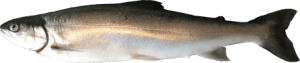
Some Icelandic Arctic charr (Salvelinus alpinus) farming facilities are increasingly confronted with outbreaks of atypical furunculosis – a disease caused by bacteria – that occurs despite the vaccination of the fish. The farmed fish have undergone selective breeding since 1992 for increased body mass and delayed sexual maturation, but bacterial resistance or disease tolerance have not yet been included in the breeding goals.
The project tested whether variation in load with the bacteria that cause furunculosis (Aeromonas salmonicida) in fish that grew under standard farming conditions can be quantified using a targeted genotyping assay (GT-seq). The GT-seq is targeted at both fish and bacterial sequences to determine a bacterial cell count standardised to fish cell counts. This method may be a non-invasive alternative to the conventional but cruel challenge tests in which fish get advertently infected with an agent that causes a deadly disease and mortality variation is recorded. If GT-seq was reliably allowing for determination of bacterial load variation (preliminary tests show it may, but the sampled fish still have to show variation), we wanted to apply genomic selection for increased bacterial resistance in the brood stock, which are the siblings of the farmed fish, with the goal to reduce furunculosis in the Icelandic aquaculture production.
Based on results from GTseq runs with two different DNA template concentrations, we now deemed the method to be inappropriate for the range of natural bacterial load in fin tissue. It may be better suited for situations or tissues with higher loads. Although we could identify some fish with higher load than others, there were too few fish with bacterial load estimates above background noise to meaningfully estimate a genetic variation or estimate breeding values. This is very unfortunate and bad news for the fish as much as it is for the aquaculture industry.
This project was funded by the Icelandic government (via Matvælasjóður) and conducted in collaboration with Theodór Kristjánsson from the Icelandic Marine and Freshwater Research Institute, Hafnarfjörður, Iceland, and Einar Svavarsson, the breeding programme manager in Hólar, Iceland, and several Icelandic farming companies.

Feasibility of a Nigerian Selective Breeding Programme for African Catfish (concluded)
Although the sturdy African catfish (Clarias gariepinus) is commonly farmed in many Asian and African countries, we do not know of any successful breeding programme in this species. In Nigeria, the African catfish is one of the commonest aquaculture species and many small-scale fish farmers would profit from fish with selectively improved suitability for aquaculture. This project investigates the requirements and conditions necessary to start a breeding programme (but will not directly initiate one) to increase the likelihood of success for a potential future breeding programme.
The project was conducted within the UNESCO GRÓ FTP programme by Ibukunoluwa Akintayo from the Nigerian Institute for Oceanography and Marine Research.
The report should become available, but still is not available for an unknown reason, at https://www.grocentre.is/ftp/media-ftp/publication.

 DebesLab